

The Nevada Critical Labor Shortage Regulation
TAKE ACTION
Information from National Coalition on Personnel Shortages in Special Education and Related Services (NCPPSSERS) “Take Action” – Strategies addressing recruitment and retention; policy recommendations; presentations; and success stories https://specialedshortages.org/take-action/‘Unprecedented crisis’: CCSD faces lawsuit over special education
Addressing Teacher Retention through Trauma-Informed Support: Teacher burnout and retention have been significant concerns nationally and locally. One possible contributing factor that remains under-examined is teachers’ exposure to trauma in their personal and professional lives. Teachers can experience multiple trauma exposures including primary trauma, secondary trauma, and collective trauma.
State Teacher Shortages 2025 Update: To understand how states are experiencing teacher shortages around the country, the Learning Policy Institute reviewed teacher workforce reports and state agency documents covering the most recent school years.
What Does the Future of the Teacher Workforce Look Like?It Depends on Where You Live
How are teacher shortages tracked?
The Learning Policy Institute tracks teacher shortages by reviewing the most recent state-specific data on the number of teachers not fully certified for their teaching assignments as well as the number of unfilled teaching positions. State laws typically specify that teachers who are not fully certified can be hired or assigned only if a fully certified teacher is not available. Therefore, both data points provide a strong indicator of the severity of shortages.
What is the state of teacher shortages?
According to the latest June 2025 analyses, 48 states plus the District of Columbia employed an estimated 365,967 teachers who were not fully certified for their teaching assignments. Thirty-one states plus the District of Columbia published data on vacancies, showing 45,582 unfilled teacher positions. Together, these estimates indicate that, at a minimum, 411,549 positions were either unfilled or filled by teachers not fully certified for their assignments, representing about 1 in 8 of all teaching positions nationally. Compared to LPI’s 2024 scan, these numbers represent an increase of approximately 4,600 teaching positions that were either unfilled or filled with teachers not fully certified for their assignments.
What are the root causes of teacher shortages?
Teacher shortages stem from two main factors: fewer people entering the profession and high rates of teachers leaving.
Teacher pipeline.Interest in teaching among high school and college students is at the lowest level it has been in decades. Enrollment in teacher preparation programs nationally dropped sharply after the Great Recession, declining by about 100,000 candidates between 2012–13 and 2014–15. Since then, the national numbers have stabilized, but with diverging trends across states. Between 2016–17 and 2020–21, 27 states have seen ongoing enrollment declines of 5% or more, seven states had relatively flat enrollment numbers, and 17 states plus the District of Columbia saw increases of 5% or more.
Teacher attrition. Attrition comprises about 90% of annual teacher demand and drives many of the shortages we see today. Less than one fifth of teachers leaving their profession are retiring; other leavers cite reasons like pursuing other careers, needing a higher salary, and dissatisfaction with teaching or their specific position.
Which subjects have the most widespread shortages?
Every year, states report data to the U.S. Department of Education on state teacher shortages. In the 2024–25 school year, these national data show:
Every state and the District of Columbia reported shortages in more than one teaching area. Shortages ranged from general elementary teachers to those in career and technical education in secondary schools.
States most commonly reported shortage areas in special education (45 states), science (41 states), and math (40 states). Collectively, 48 states reported shortages in at least one of these three teaching areas— areas that have had shortages since at least 1990, when the Department of Education began collecting these data.
The numbers of shortage positions were deepest in special education, elementary education, language arts, and career and technical education. These teaching areas account for the highest numbers of teacher shortages nationwide, as measured by the number of positions that are vacant, filled by temporarily certified teachers, or filled by out-of-field teachers.
How do teacher shortages impact students and school districts?
Persistent teacher shortages affect all types of districts, from rural to urban, and all states small to large. Shortages have particularly negative consequences for:
Student learning. When districts and schools face shortages, they often hire underprepared teachers or those not fully certified for their assignments; staff classrooms with substitute teachers; increase class sizes; cancel courses; and add responsibilities to existing teachers. All these things undermine student achievement.
Students from lower-income backgrounds and students of color. These students often have the most limited access to certified and experienced teachers and are disproportionately impacted by teacher shortages. Schools with the highest concentrations of students of color are 4 times as likely to employ an uncertified teacher compared to schools with the lowest concentrations.
District budgets. Teacher shortages are primarily driven by teachers leaving the classroom and profession, harming not only student achievement but also district finances. Districts incur costs that total between about $12,000 and $25,000 for every teacher who leaves, depending on district size. These include the costs to separate from teachers who leave, as well as costs to recruit, hire, and onboard new teachers.
Rural districts. Rural districts are particularly impacted by teacher shortages, which can be a result of smaller tax bases that prevent rural districts from offering competitive salaries, greater distance from educator preparation programs, and difficulty in filling vacancies that can result in higher reliance on out-of-field teachers.
What can policymakers do to end teacher shortages?
Local, state, and federal education leaders and policymakers all play important roles in reducing pervasive teacher shortages. Research suggests the following strategies are key to building a strong and stable teacher workforce:
Invest in high-quality, widely accessible, financially supported pathways into teaching. Teachers who receive affordable, high-quality, comprehensive preparation, such as that offered by teacher residencies, tend to stay in teaching longer and are more effective.
Provide beginning teachers with mentoring and induction supports. New teachers who are mentored and well supported become effective sooner and stay in teaching longer than those who lack mentoring and support.
Provide competitive compensation and improve working conditions. Turnover is one of the key causes of teacher shortages because most open positions are created by teachers leaving the profession before retirement. Increasing teacher compensation and improving working conditions positively impact recruitment and retention efforts.
Strengthen data accessibility and data system infrastructure. Access to data that is consistent, accurate, transparent, timely, and routinely updated enables policymakers and stakeholders to better understand teacher shortages and devise informed policy solutions.
Recruitment Efforts
National
Some states are moving to a 4-day week (Texas)- offering $ incentives for educators-and bonus for hiring high needs which includes special education teachers.
Des Moines, Iowa- offered as much as $50,000 in additional pay and bonuses for educators to stay on
NATIONAL COALITION ON PERSONNEL SHORTAGES IN SPECIAL EDUCATION AND RELATED SERVICES
In Nevada-
Nevada State Teacher and Education Support Professional Recruitment and Retention Advisory Task Force 2024 Report
Nevada Department of Education Announces New Educator Workforce and Class Sizes Portal
WCSD at 91% capacity and offering additional compensation for special education teachers and related services personnel over caseload-
WCSD negotiated an additional 2 days of pay for SLPS for 2022- 2023 school year
Additional incentives $3000 for all educators-
Clark County offered $5000 Signing Bonus
The Nevada Critical Labor Shortage Regulation
Why the shortage?
The Economic Policy Institute reports a projected shortfall of around 200,000 public school teachers by the 2025-26 school year without significant intervention. Add to that the fact that 340,000 fewer students enrolled in teacher preparation programs in 2018 than in 2010.
In 2019, the Economic Policy Institute published on the growing teacher shortage, citing experts such as Linda Darling-Hammond, one of the foremost authorities on teacher education. The article concluded a number of factors affect educator shortages — working conditions, low pay and school and community environment, among others — and that the problem will only get worse if underlying causes are not addressed. The last three years have proven that statement true.
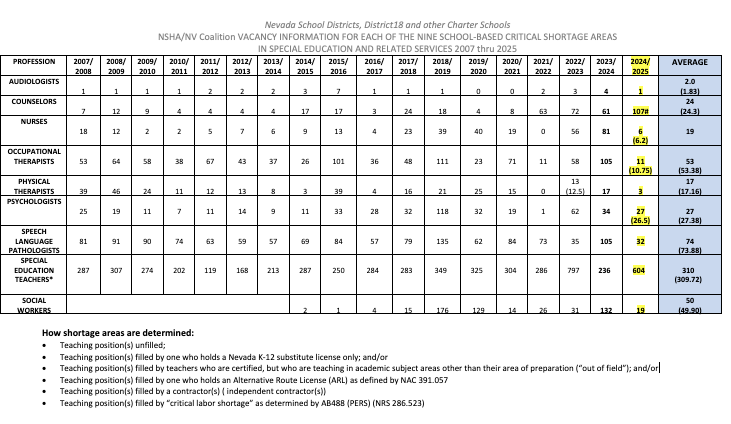
Nevada Personnel Shortages
Since 2007-The NV Coalition have been collecting Nevada's special education related service personnel shortages. Click on the chart to find out more about the changes throughout the years.
Resources and Information about shortage solutions